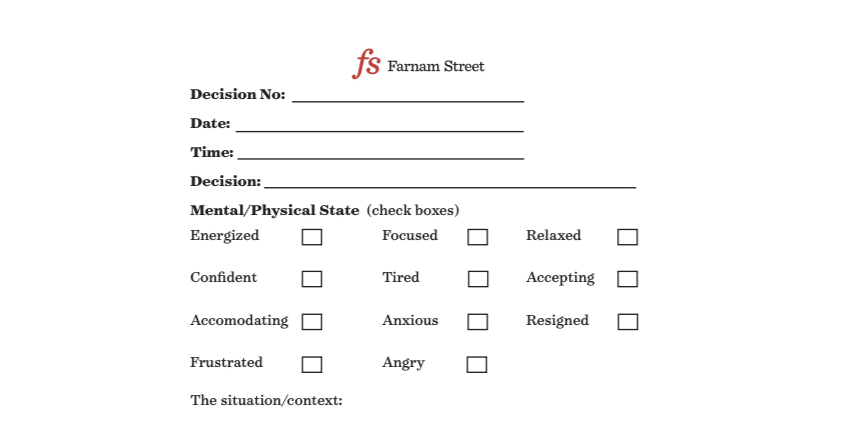
 The original decision journal template from Farnam Street.
In 2016, while I was reading everything I could to improve my skills and keep my company afloat, I stumbled upon Peter Drucker’s book Managing Oneself.
I remembered one thing from it—you should leverage your strengths. You need to understand them well—and also what’s blocking you from reaching your full potential.
In order to discover your strengths, Drucker advises writing down what you expect will happen every time you make a major decision or take a key action. After nine or twelve months, you should review your assumptions against the actual results to get insights. In his own words:
“Practiced consistently, this simple method will show you within a fairly short period of time, maybe two or three years, where your strengths lie—and this is the most important thing to know. The method will show you what you are doing or failing to do that deprives you of the full benefits of your strengths. It will show you where you are not particularly competent. And finally, it will show you where you have no strengths and cannot perform.”
A year or two later, I learned about another method, Decision Journaling, from the blog Farnam Street. The idea was to record your decisions, ideally in a standardized way, to improve your decision-making over time. This immediately reminded me of Drucker’s book. Whenever I hear about something from a few reputable and independent sources, I’m often willing to try it.
Over twelve months, I wrote down five decisions I thought were worth learning from. I noted the context for each decision, the problem statement, different scenarios of what could happen, etc. I also reviewed them after seven to sixteen months, depending on the decision.
And, to be honest, I hadn’t learned anything valuable enough to keep me going. The process was off-putting, felt like a duty, and the insights from comparing what I imagined with what actually happened were relatively minor. I’m a fairly disciplined person, and I understand that often you need to be patient and keep going to get results. But in this case, it was simply too dull to sustain. I dropped the idea and moved on.
Four years later, I became interested in decision-making again and thought it would be good to revisit my notes. I knew it might be an interesting and sometimes embarrassing experience, similar to looking at your old photos. It turned out to be a good call. I was astounded by what I saw.
My writing was chaotic, lacked clear objectives, was full of imprecise language, and sometimes even lacked conviction. Above all, I approached the exercise in the wrong way. I intended to justify the decision I’d already made, instead of trying to explore what might have been the best option. No wonder I didn’t see improvements in my decision-making.
At the same time, I had completely forgotten that Drucker wanted me to discover my strengths—not directly improve my decisions. I mixed up, on the surface, two similar methods and forgot the difference between their purposes. Nevertheless, reading the notes after a few years gave me an unfiltered view into my past thinking.
Not all the insights were new, but I could see more clearly how my thinking had evolved. For example, I’ve become better at imagining a wide range of outcomes. On the other hand, I’m not so good at assigning probabilities to events or creating contingency plans. This level of detail in my strategic skills makes it much easier to introduce targeted improvements.
There are two main lessons I’ve taken from writing down my decisions:
- In the short run, structure matters. Unless I clearly define my objectives, assumptions, possible solutions, and the probabilities of different outcomes, I get little value from the process. When my notes are too abstract or vague, almost any result can seem to “fit,” which makes it impossible to judge how strong—or flawed—my decision process really was.
- In the long run, even chaotic notes reveal patterns. Revisiting them after a few years showed me which parts of my thinking had grown stronger, which remained weak, and what that said about my strengths and weaknesses. As Drucker suggested, this kind of clarity only comes with time.
If you’re considering—or already keeping—a decision journal, be clear about your purpose. If your goal is to improve your decision-making in the short run, focus on structure and clarity so that each entry gives you actionable feedback.
If your goal is to better understand your strengths and weaknesses over time, focus less on perfection and more on consistency. Write regularly, then revisit your notes when enough time has passed to reveal patterns in your thinking.1
Most importantly, don’t confuse these two purposes as I did. Mixing them together left me frustrated in the short run and nearly caused me to abandon the practice entirely—when in reality, the long-term value was waiting for me all along.
Notes
-
To avoid confusion, decisions should be reviewed within roughly six to twelve months of writing them. That’s usually enough time to compare what you thought would happen with reality. This is what both Drucker and Farnam Street advise. But apart from that, to see your strengths and weaknesses better, you need to read through them again, likely after a few years. ↩